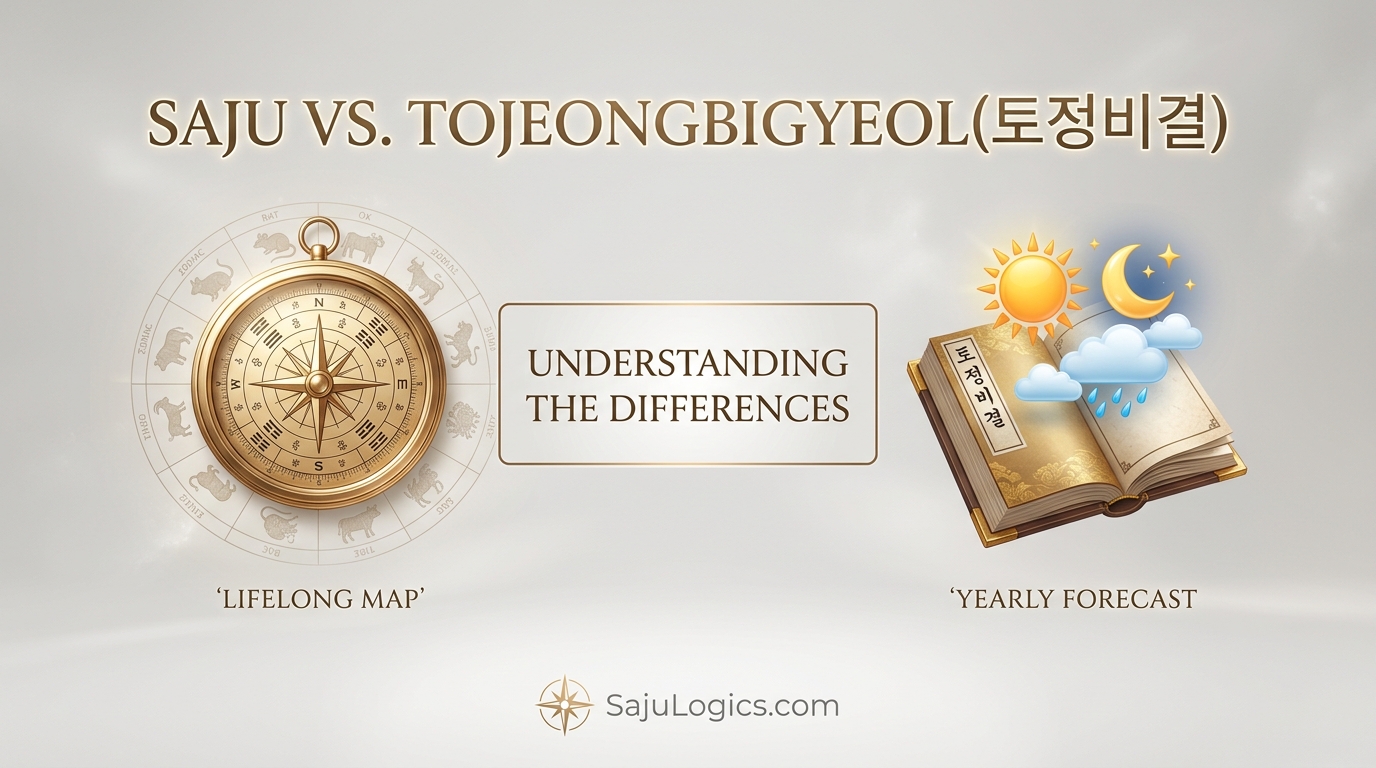
When it’s time for a new year or a major life decision, Koreans often turn to two distinct yet overlapping systems of destiny: Saju (Four Pillars of Destiny) and Tojeongbigyeol (The Secrets of Tojeong). While they may seem identical to the untrained eye, they originate from different cultural roots and operate on entirely different mathematical logics. Today, let’s explore the contrast between the rigorous Chinese statistical system of Saju and the uniquely Korean practical oracle, Tojeongbigyeol.
1. Saju: The Grand Cosmic Blueprint (Chinese Origin)
Saju Metaphysics (Myeongni-hak) is rooted in Ancient China. Starting with Li Xuzhong in the Tang Dynasty and refined by Xu Ziping in the Song Dynasty, it is a sophisticated system analyzing how the Yin-Yang and Five Elements (Wood, Fire, Earth, Metal, Water) interact with a human’s moment of birth.
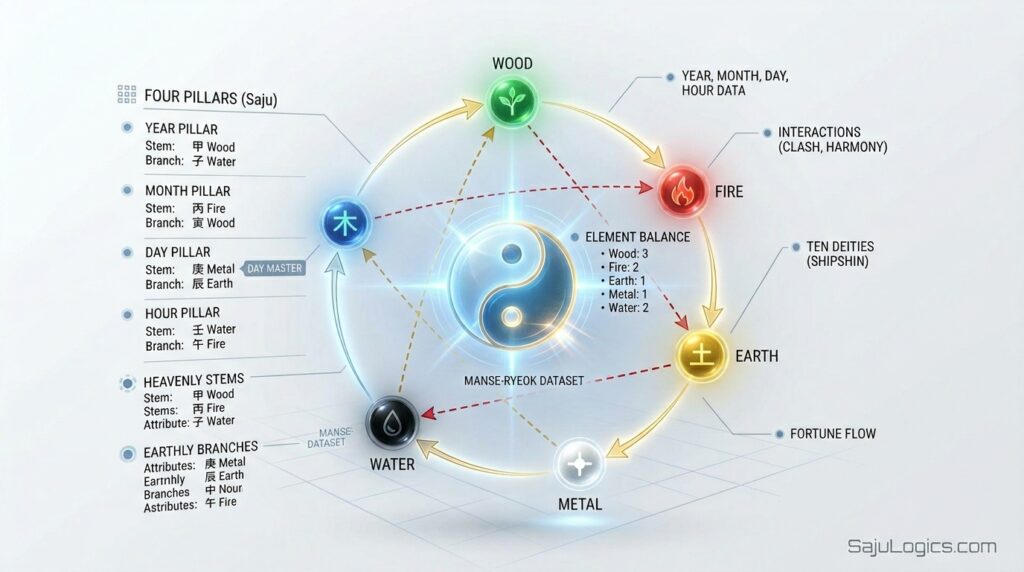
● The Core Logic: The Interplay of Five Elements
Saju is based on four “pillars” (Year, Month, Day, and Hour) and eight characters (Palja).
- Data Input: Your birth data is converted into 10 Heavenly Stems and 12 Earthly Branches using the Sexagenary Cycle (Manse-ryeok).
- The Algorithm: It doesn’t just read the characters; it calculates the ‘Relationship’ between them. Centered on the “Day Master” (representing the self), the system computes whether other characters support (Sheng) or attack (Ke) that energy.
- The Output: It yields a macro-level blueprint of one’s life capacity (Guk) and major destiny cycles (Dae-un).
Saju is a reflection of the vast and meticulous Chinese philosophical tradition, acting as a lifelong strategic map.
2. Tojeongbigyeol: The People’s Annual Survival Guide (Korean Origin)
In contrast, Tojeongbigyeol is a uniquely Korean system attributed to the Joseon-era scholar Yi Ji-ham (pen name ‘Tojeong’). While Chinese Saju was a complex academic pursuit for the elite, Tojeongbigyeol was designed as a K-Fortune Algorithm that commoners could easily use to navigate their yearly lives.
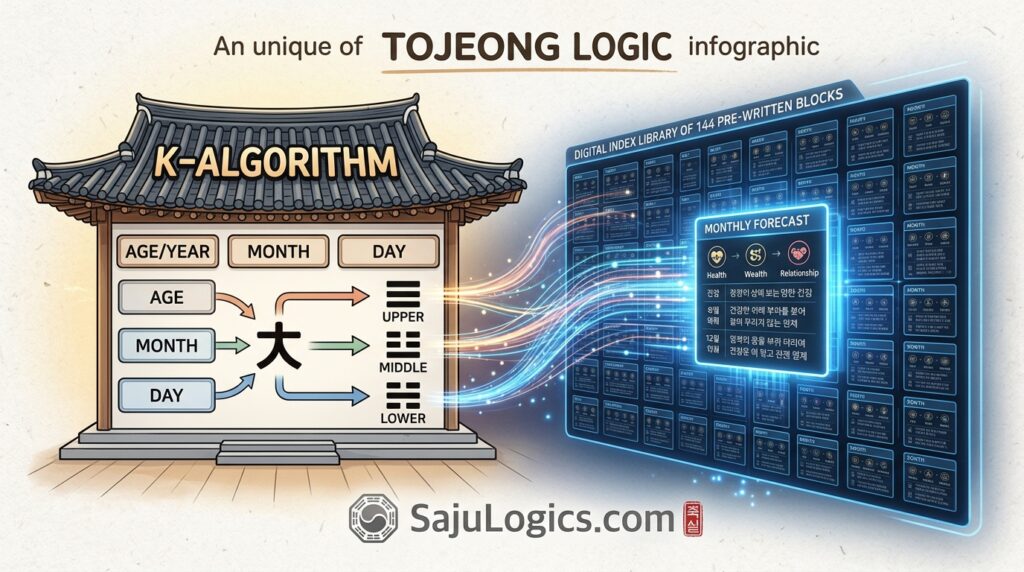
● The Core Logic: Trigrams and Numerical Indices
Unlike Saju, Tojeongbigyeol famously omits the ‘Hour’ of birth. It uses only the Year, Month, and Day through a unique trinary logic:
- Upper Trigram (Sky): Calculated by combining your age and birth year.
- Middle Trigram (Human): Derived from your birth month and the current year’s lunar cycle.
- Lower Trigram (Earth): Derived from your birth day.
Combining these three results in 144 fixed hexagrams. While Saju is a ‘variable-based’ logic with tens of thousands of permutations, Tojeongbigyeol is an ‘indexing logic’ (finding one of 144 pre-written results). This reflects the Korean spirit of practicality—making future-planning accessible to everyone.
3. Key Differences: Chinese Saju vs. Korean Tojeongbigyeol
I. Precision vs. Accessibility
Chinese Saju requires the ‘Hour of Birth’ for accuracy. Without it, the analysis is incomplete. Korean Tojeongbigyeol intentionally sacrificed the hour to ensure that Joseon peasants, who rarely had clocks, could still check their fortunes. It traded extreme precision for maximum accessibility.
II. Logic vs. Intuition
Saju follows Elemental Logic (“You lack Water energy, so seek Metal”). Tojeongbigyeol, however, provides direct, metaphorical instructions (“A benefactor will appear from the East,” “Avoid travel in October”). It is optimized for the ‘clear-cut’ answers that Koreans favor.
III. Self-Cultivation vs. Risk Management
Chinese Saju is often about understanding one’s destiny and self-cultivation. Korean Tojeongbigyeol is purely about ‘Chugil-Pihyung’ (Seeking luck and avoiding misfortune). It acts as a safety guidebook, warning you exactly when to stay cautious.
Conclusion: Designing Your Life
Think of Saju as the type of car you were born with—is it a sturdy SUV or a fast sports car? Tojeongbigyeol, on the other hand, is the weather report for the road ahead this year.
By combining these two, you get the best of both worlds: a lifelong map to understand who you are, and a yearly forecast to know when to hit the brakes. Today, with AI-driven platforms like SajuLogics, these ancient Eastern algorithms are becoming more precise than ever, helping modern users navigate their fate with data-backed wisdom.
What does this year hold for you?
Prepare for your year ahead with a detailed analysis of your fortune and key opportunities.
Get Your Free Yearly Saju Now