
In Saju (Four Pillars of Destiny), the Earthly Branches—the four characters located in the bottom row of a natal chart—play a decisive role in shaping an individual’s environment and behavioral patterns. Among these, “Dohwa” (Peach Blossom) is a critical variable that determines the intensity of one’s social magnetism and romantic dynamics.
1. The Definition and Structural Logic of Dohwa
The term “Dohwa” (桃花) literally translates to “Peach Blossom.” Metaphorically, it represents a powerful attractive force that draws people in. In a Saju chart, Dohwa is identified by the presence of four specific Earthly Branches:
Zi (子) / Mao (卯) / Wu (午) / You (酉)
The frequency and placement of these four characters in your Year, Month, Day, and Hour branches dictate the scale of your interpersonal influence.
2. Relationship Dynamics by Dohwa Count: Case Studies
Case 1: 1 Dohwa – The Stable Type
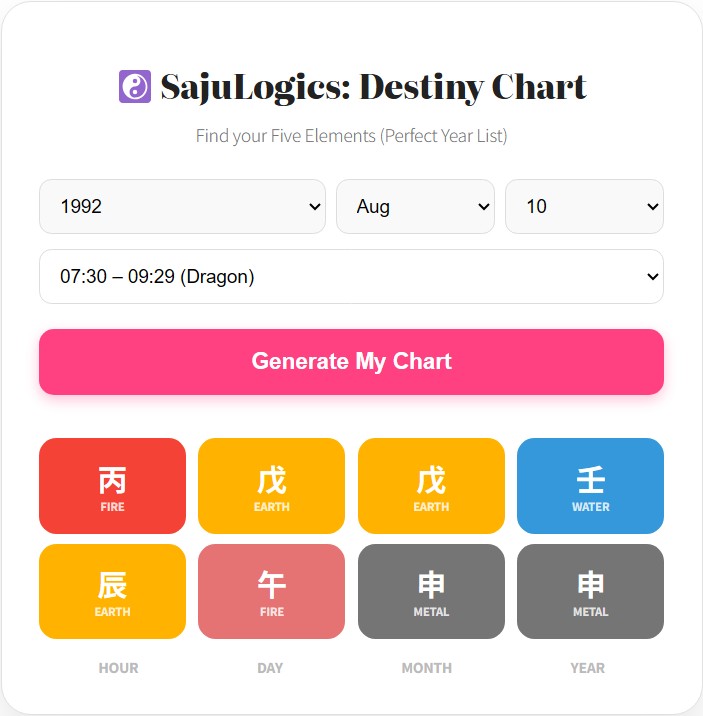
- Reference Date: August 10, 1992 (07:30–09:29)
- Dohwa Character: Wu (午)
- Total Count: 1
- Pattern: This chart contains a single Dohwa element (Wu), indicating a balanced and controlled form of attraction. The individual is naturally likable but maintains clear emotional boundaries. They prioritize emotional security and loyalty, favoring long-term, stable relationships over complicated romantic entanglements.
Case 2: 2 Dohwa – The Socially Active Type
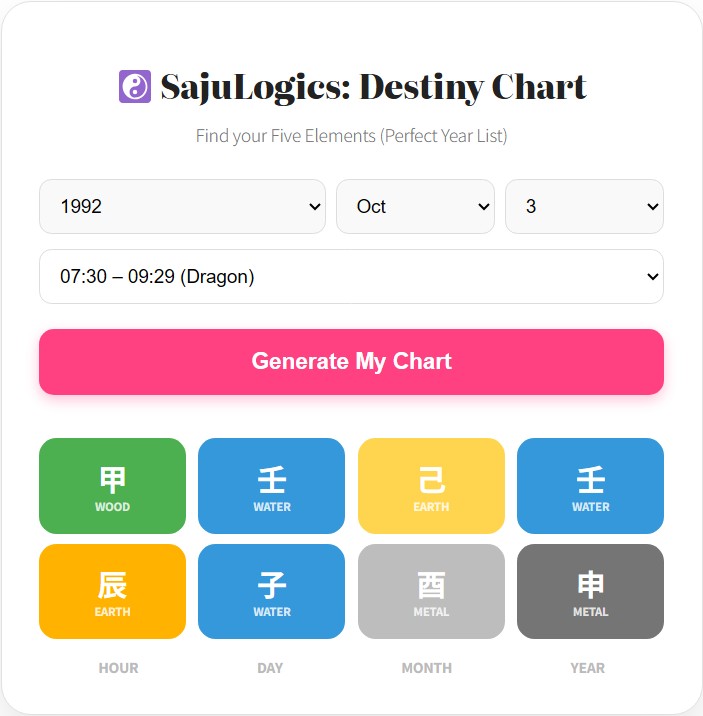
- Reference Date: October 3, 1992 (07:30–09:29)
- Dohwa Characters: You (酉), Zi (子)
- Total Count: 2
- Pattern: With two Dohwa elements present (You and Zi), this chart reflects a noticeable increase in social visibility. The individual naturally commands attention and often finds themselves in socially active environments. There is a higher frequency of romantic interactions, and they may experience a higher volume of dating compared to the stable type.
Case 3: 3 Dohwa – The High-Tension Type
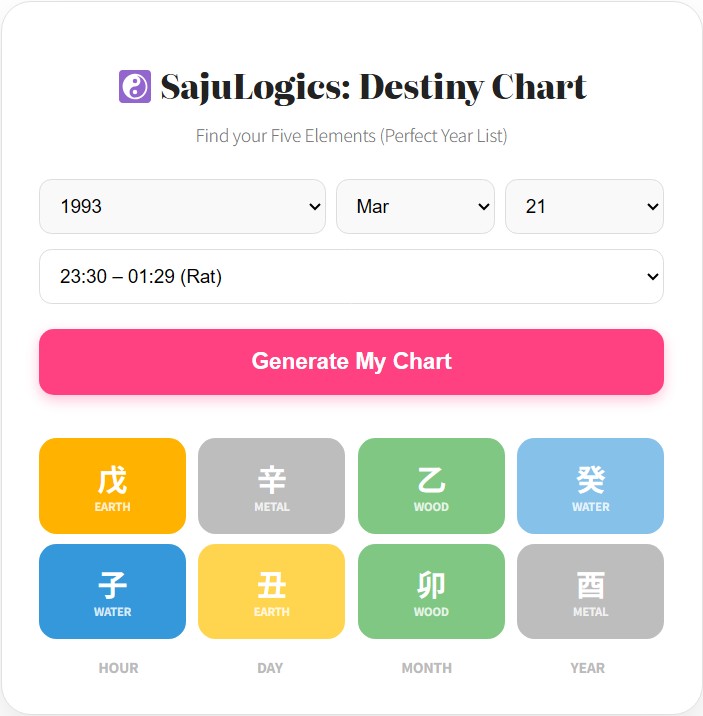
- Reference Date: March 21, 1993 (23:30–01:29)
- Dohwa Characters: You (酉), Mao (卯), Zi (子)
- Total Count: 3
- Pattern: A magnetic presence that is difficult to ignore. While there is a constant influx of new relationships, this type is prone to emotional volatility and complex entanglements. They may suffer from emotional exhaustion due to the sheer intensity of their romantic life.
Case 4: 4 Dohwa – The Excess Type
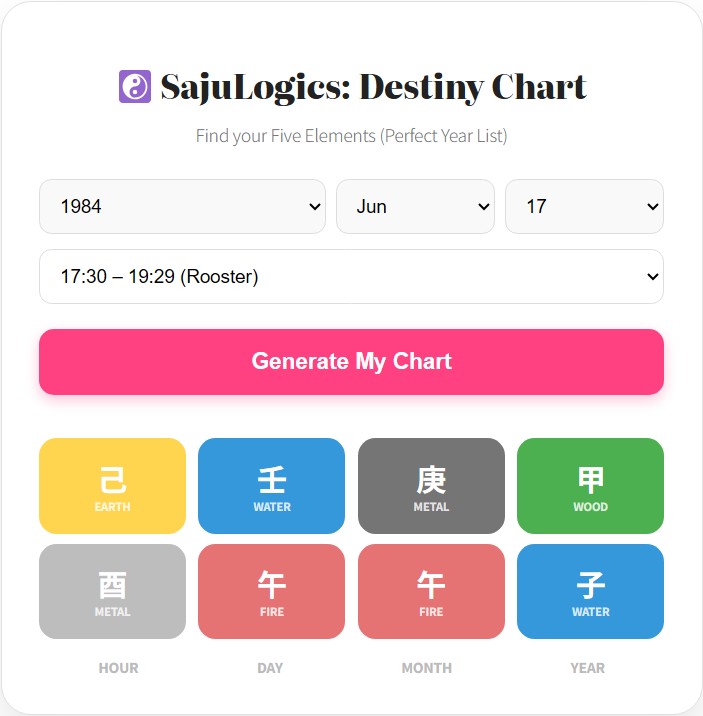
- Reference Date: Jun 17, 1984 (17:30 ~ 19:29 PM)
- Dohwa Characters: You (酉),Wu (午) , Wu (午), Zi (子)
- Total Count: 4
- Pattern: A rare chart saturated with all four Dohwa energies. Life often revolves around interpersonal and public issues. While receiving overwhelming attention, a lack of internal grounding can lead to a collapse of daily balance. For this type, high-level emotional discipline is the primary life lesson.
3. Conclusion: Opportunity vs. Action
A common misconception is that a high Dohwa count inevitably leads to infidelity. From a Saju perspective, Dohwa represents “opportunity and environment,” not “behavioral choice.” Having multiple Dohwa branches simply means living in an environment where one is more frequently exposed to temptation.
Ultimately, the integrity of a relationship depends on individual values. However, recognizing strong Dohwa energy allows one to channel it productively into fields such as the arts, sales, or public relations, which is the most effective way to balance this potent energy.
[Action Item] Check your Saju chart now. How many of the four branches—Zi (子), Mao (卯), Wu (午), or You (酉)—appear in your Earthly Branches?
Check Your Destiny Chart
Discover your Earthly Branches and calculate your Dohwa energy with our professional Manse-ryeok tool.
Get Your Free Manse-ryeok Chart Now